The 2024 EM 385-1-1 Overhaul: What’s Still Relevant in 2026?
June 4, 2026
Top Benefits of Renewing Your OSHA Certification Courses Every 3 Years
July 24, 2026Online vs. In-Person Confined Space Competent Person Training: Pros and Cons
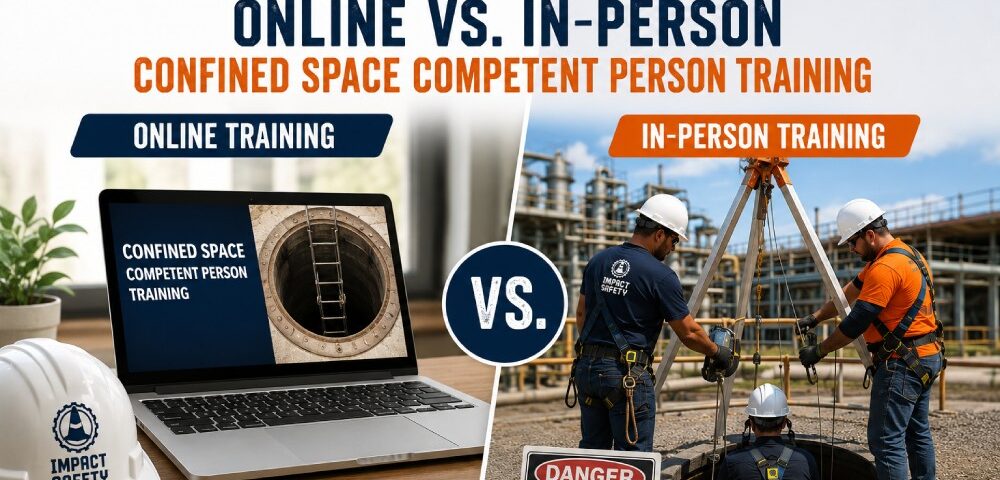
Weighing online and in-person confined space competent person training so your crews get the compliance coverage and the hands-on skill they actually need.
Choosing the right training method for confined space competent person training can impact both workplace safety and regulatory compliance. With options for online and in-person instruction, organizations need to understand the pros and cons of each method to determine what works best for their team.
In this post, Impact Safety Inc breaks down how each approach affects learning, skill mastery, and overall safety culture, and where a hybrid model delivers the strongest results.
In This Article
The Foundation
What Is Confined Space Competent Person Training?
Confined space competent person training equips workers with the knowledge and skills to safely enter, work in, and supervise confined spaces. These programs teach hazard recognition, permit-required procedures, emergency response, and compliance with OSHA safety standards. Proper training reduces accidents, ensures regulatory compliance, and fosters a safety-first culture.
Option One
Online Training: Benefits and Drawbacks
Online delivery is built around access. Crews complete coursework around live work, and the employer avoids the overhead that comes with pulling people to a classroom.
Flexibility Employees can complete training anytime, anywhere, without impacting project schedules
Cost-effective Eliminates travel, lodging, and facility costs
Self-paced learning Trainees can revisit modules as needed for better retention
Interactive tools Includes simulations, videos, and quizzes to reinforce learning
Online training provides convenience without sacrificing the key theoretical knowledge required for OSHA safety training.
The tradeoffs sit on the practical side of the program, and they matter in high-risk work:
Limited hands-on experience Trainees may miss practical exposure to real confined space equipment
Less immediate feedback Instructors cannot correct techniques in real time
Potential engagement challenges Self-paced courses may not engage all learners effectively
While online training is convenient, organizations may need supplementary hands-on exercises to reinforce skills.
Option Two
In-Person Training: Benefits and Drawbacks
Classroom and field instruction puts trainees in front of the equipment and the instructor at the same time, which is where technique gets corrected and habits get built.
Hands-on practice Trainees work with real equipment and confined space scenarios
Immediate instructor feedback Trainers can correct mistakes and ensure proper technique
Team collaboration Encourages discussion and peer learning
Better retention Physical practice often leads to stronger skill retention
In-person programs deliver comprehensive, practical learning essential for high-risk work environments. The constraints are logistical rather than instructional:
Higher costs Travel, venue, and instructor fees can increase expenses
Scheduling challenges Requires alignment of team availability with class schedules
Limited accessibility May not be available in all regions
Despite logistical challenges, in-person training provides invaluable hands-on experience critical for OSHA safety training.
Making the Call
Comparing Online vs. In-Person Training: Which Is Right for You?
Choosing the right format depends on factors such as:
Team size and location
Project deadlines and operational flexibility
Budget constraints
Compliance requirements
Hybrid approaches that combine online theoretical modules with in-person practical exercises often deliver the best of both worlds, ensuring employees are fully competent and confident in confined-space operations.
Your Training Partner
Impact Safety Inc: Expert Confined Space Competent Person Training
Impact Safety Inc provides industry-leading confined space competent person training, both online and in-person. Our programs are designed to:
Meet OSHA safety standards and regulatory requirements
Provide hands-on, real-world training scenarios
Offer flexible scheduling for diverse teams
Ensure employees are confident, competent, and compliant
Partnering with Impact Safety ensures your workforce gains the knowledge and practical skills necessary to operate safely in confined spaces. Both formats offer real benefits: online training provides flexibility and cost savings, while in-person sessions deliver essential hands-on experience. Evaluating your team’s needs and leveraging hybrid solutions can optimize learning outcomes, and you can review the full course lineup in our safety training catalog.
Common Questions
FAQs: Confined Space Competent Person Training
Get Your Team Confined Space Certified
Talk with Impact Safety Inc about online, in-person, or hybrid confined space competent person training built around your crew and your schedule. Explore confined space competent person training programs.